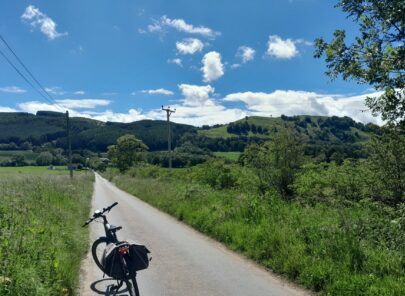
From a recent e-bike ride from Perth over to Dunning, then up and along the B934, crossing over the Ochil Hills (photo above) and on to Rumbling Bridge along quiet roads.. then on a loop back to Perth via Kinross/Milnathort, Loch Leven, and Glenfarg.. an enjoyable 76km bike tour with a few breaks. You get to see and hear so much more when out cycling..

This bike tour took around 4 hours, with a stop at the rather unique Rumbling Bridge, of which the lower section was originally built back in 1713, and then the upper section of that bridge which we still use today was built in 1816. This construction (building one bridge with an arch on top of the other bridge without parapets) has resulted today in a constant rumbling noise from the rushing water coming from the river below, while the nearby gorge is a dramatic looking canyon in seemingly otherwise tranquil countryside.. because when one is stood back up on the road and bridge (photo below, with one of our e-bikes) it is totally quiet and you can’t hear those rumbling noises below.

Rumbling Bridge is situated on the river Devon (formally Dovan), which runs through an area known as the crook of devon, from the Ochil Hills all the way over to where it joins the River Forth, just west of Alloa (Clackmannanshire) and east of Stirling. This river, downstream from the bridge, beyond the waterfall, is a very popular location for fishing (Brown Trout, Sea Trout and Salmon) - The Caldron Linn, or the Cauldron Linn, is a waterfall about a mile below Rumbling Bridge, on the River Devon at the border between the counties of Clackmannanshire and Perthshire (now Perth & Kinross), while this waterfall was famously visited by Robert Burns in 1787 in the company of his friends, and was then later featured in his verse "The Banks of the Devon." - How pleasant the banks of the clear-winding Devon.. (where) meandering flows (across the landscape).. The lyrics from the complete verse can be read at;
https://www.bbc.co.uk/arts/rob...
And in case you are curious, a meander or ‘meandering flow’ is another name for a bend in a river.. meander is when water flows in a curvy, bendy path, like a snake… the River Devon has plenty of these types of bends.
The waterfall that kept changing location..
Prior to 1971, the Caldron Linn/Cauldron Linn was actually still in the most southerly tip of Perthshire, before its location was transferred to Clackmannanshire.. then to Kinross-shire, then fast forward a few decades (and by ignoring the period 1975 till 1996 when Scotland made use of a region they decided to call ‘central’, or even ‘Tayside’), and it now falls back under Perth(shire) or PKC again according to current boundaries. But if you think that is confusing, then spare a thought for the people who had to draw up this UK act of parliament which was responsible for these boundary changes, when they even ended up having to use the abbreviation or term ‘etc’ in the actual title of this act?! – curious?.. Then for more info go check out; the Local Government etc. (Scotland) Act 1994 that tries to explain how Scotland dealt with all their regions and districts 😉
Rumbling Bridge location..
Also worth mentioning, is that this Rumbling Bridge is NOT to be confused with another one in the Perthshire region that has been going by a similar name over recent years, located on the River Braan, a few miles west of Birnam/Dunkeld on the old military road (the A822 on maps today) towards Amulree and Crieff. The distance from this Rumbling Bridge (the original) located south of Perth, to that one incorrectly tagged on google reviews (north of Perth) is actually 35 miles (55 kms) apart!
It seems that since 2020 and the lockdown period, a lot of people walking out of Birnam or nearby camping/caravan sites have been posting google reviews about ‘Rumbling Bridge’ and tagging it there, rather than at its original location on the River Devon as featured in this post. So, if you want to see more of Perthshire, then ditch google and get out on your bikes!
Rumbling Bridge (the village next to the bridge, on what is now known as the A823) even used to have its own railway station, which was operational on the Devon Valley Railway (linking Alloa with Kinross) between 1863 till 15th June 1964.
All photos by HBT
Other posts you might like


Scone Palace – Kinnoull Hill – Moncreiffe Hill
Half Day bike tour options from Perth..


What our guests say

Book your Tour
How to book your Tour
There are no cash payments at the premises, so all tours must be booked in advance.
Please note that there are only a maximum of 4 places on any given tour.
To book and reserve your place on one of our tours you can use the Fareharbor Booking system (via orange BOOK NOW link), or for all enquiries send us an email to [email protected], or simply complete the Contact Us section. As there are only 4 slots on any of our tours we operate on a first-come first-served basis with all our bookings. Please also include the height of each person - We will then supply you with the correct frame size.
It is also worth mentioning that if the ‘private tour’ option has been booked in advance then there are no other places or bikes available on that day. For more info about the ‘private tour’ (from 1 up to a maximum of 3 people for the same fee) please see our Tours section, or simply contact us by email or via the website.
Highland Bike Tours (HBT) make use of Hybrid E-Bikes with a classic Dutch design, so suitable to use while wearing casual clothing. You can view images of these e-bikes on the FAQs page (see above), in our Blog section, or in some of our Instagram posts (see below).
Solo travellers wishing to take part in a Bike Tour: Although there is the 'private tour' option (for 1 to 3 people), all of our shared tours require a minimum of two people, so if you would like to take part in one of our tours and are travelling alone, then feel free to contact us with your preferred travel date, and we will do our best to match you up with others in a similar position.
Guided E-Bike Tours also in the Dutch language. NL: Samen met een Nederlandssprekende tourgids ervaar je al het moois dat de Schotse Hooglanden te bieden heeft op een unieke manier.